

by David Stalling
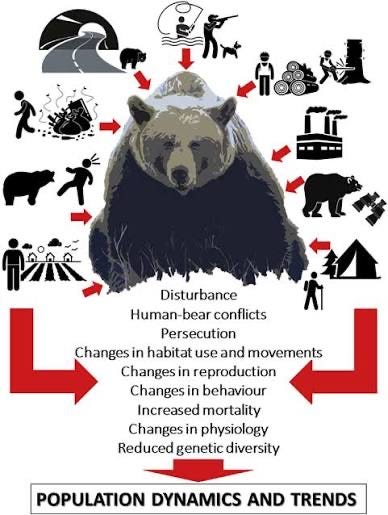
Regarding grizzly bear recovery, I often hear people say, “We’ve reached population recovery goals,” as if population size tell the whole story about.
It doesn’t.
There’s far more to healthy wildlife populations than population size, particularly with apex predators such as grizzlies. The Great Bears evolved as predators, without much predation. They are not a prey species such as elk or deer. Their population size is not “controlled” or “kept in balance” by predators — human or otherwise.
Grizzlies maintain a hierarchy and social structures, along with particular breeding and territorial behaviors. When such things are altered (for example, when a dominant male Grizzly is killed) it can lead to disruption of some of these territorial behaviors, breeding and social structures. It can increase infanticide (when young males wanting to take over dominance might kill cubs sired by the previous dominant male. . . Increased fighting among bears, more harassment of female bears, more contact and more conflict with humans) and mother bears may push away their cubs earlier so their cubs don’t learn as much, and so on.
All of this, and more, while at the same time more humans are moving into and recreating in bear habitat; bears are moving around more in search of new and alternative food sources as their habitat continues changing rapidly from climate change, and there remains a lack of connectivity between genetically isolated populations.
In other words, there are a lot of factors that can put species at risk — including age structures, male to female ratios, breeding and territorial behaviors, and the timing of birthing — not only negatively effecting short-term health, but long-term genetics and evolution.
Wolves provide a good example: When certain wolves are killed, it can alter social structures and other behaviors within packs, throwing some wolf packs into disarray, causing packs to break up, putting more stress on females, causing increased competition, sometimes more breeding and more wolves . . .
In a lot of our hunted elk herds, there are too many hunters with too much high technology gear, and too easy access, where elk don’t have a lot of habitat security, all making hunted elk — particularly bull elk — more vulnerable. In some places overly vulnerable.
This results in low bull-to-cow , and a lack of mature balls. It has disrupted a lot of breeding behavior, particularly timing, causing calves to be born later in the spring when there isn’t good spring forage, and not all at once (known by wildlife biologists as a flooding strategy, and overwhelm the predators) which is making them more susceptible to predation.
The sad irony: most hunters know this. The research they like to brag about clearly shows it. Research done by state wildlife agencies with funding from hunting groups like Safari Club and the Rocky Mountain Elk Foundation, and conducted by students in university wildlife programs) But they mostly ignore it.
And they go on claiming and pretending that healthy wildlife is just a matter of population size and numbers.
Because predators evolved with little predation, they have developed more intricate social structures and breeding and territorial behaviors, that can be disrupted when unnatural predation, by human predators, occurs on predators.
Research is clear: killing predators often exacerbates the problems hunters (and wildlife managers, wildlife commissions and politicians working to appease hunters) claim to be addressing — and often leads to increased conflicts between predators and humans.
There is no biological, moral or ethical reason to hunt grizzlies.
None!