

by David Stalling
When I’m feeling down, I like to go for walks — through the woods, up in the mountains, along a stream, or even just around town — with one simple goal: find something that sparks my curiosity. I look for one thing that intrigues me enough to make me want to learn more. Researching nature, wildlife, and natural history helps pull my mind away from whatever is bothering me. Learning makes me happy, and curiosity is often the best medicine I know. So I’m going to share some of those discoveries here:
I was walking along the creek the other day, doing what I’ve done for a good part of my life—watching the water, studying the rocks, reading the current and looking for the little clues that tell you what’s really happening beneath the surface.
If you’ve spent enough time fishing, you develop a habit of looking at things most people would never think twice about. You start seeing the creek differently. A ripple can mean something. A rock can hold a whole neighborhood. And a tiny speck of sand and gravel stuck to a larger rock can turn out to be an entire life story.
That’s what caught my attention this time.
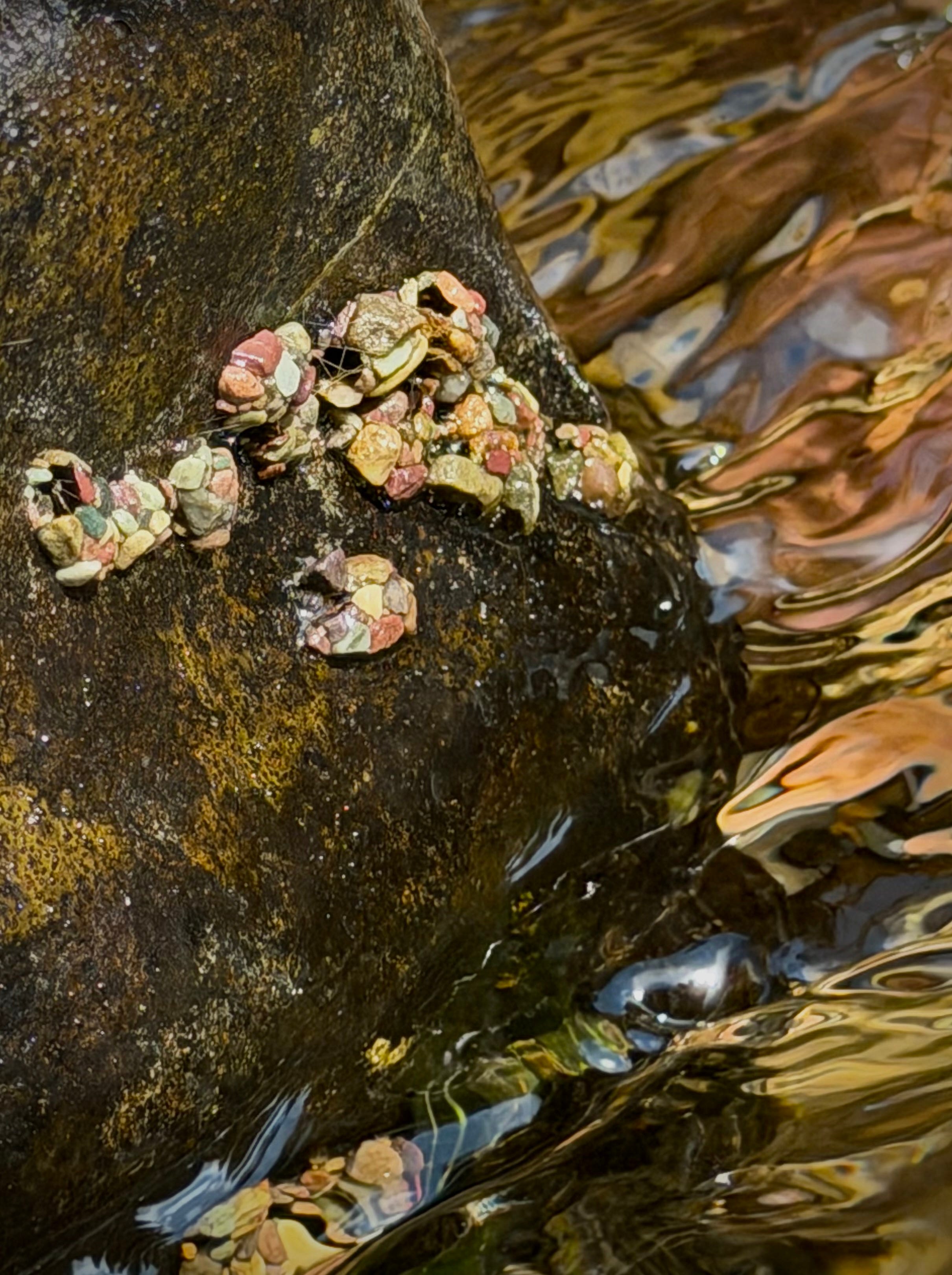
Down in the clear water, attached to the larger rocks along the creek bottom, were these small, colorful little stone casings. Smaller than the nail on my pinky. Just a tiny bit of rock and sand, shaped and held together into what looked like a miniature little shelter.
The amazing thing wasn't finding one. There were lots of them.
Once I knew what I was looking at, I started seeing them everywhere—little bits of gravel and sand attached to the larger rocks, sitting there in the current like somebody had scattered microscopic pieces of jewelry across the stream bottom.
I knew they had something to do with a nymph. When I got home I did more research.
They are caddisfly cases. Caddisflies are aquatic insects whose larvae spend much of their lives underwater. And some of them build protective shelters out of the very material that surrounds them. Tiny pieces of sand. Tiny pieces of gravel. Sometimes bits of vegetation or other debris. And they hold it together with silk.
Think about that. A creature smaller than the nail on my pinky is living in a moving creek, collecting microscopic bits of the stream bottom and using silk as an underwater adhesive to construct its own little piece of armor.
It’s basically a tiny underwater mason. No tools. No blueprint. Just instinct and millions of years of evolution.
Different caddisflies build different kinds of structures. Some make portable tubes that they carry around with them. Others construct shelters directly against rocks. The shape and materials can be distinctive enough that experienced naturalists can sometimes identify the family or even genus just by looking at the case.
And these little shelters aren't just homes. They're protection.
The larva has a soft body, and the case gives it some armor while it moves around in the current and searches for food—or attaches itself to large rocks and waits for the current to bring food to it.
Many caddisfly larvae are grazers, scraping algae and other material from the surfaces of rocks. Others collect particles, shred plant material, filter food from the current, or prey on other tiny organisms.
The more I learned about those little cases, the more fascinating the whole life cycle became.
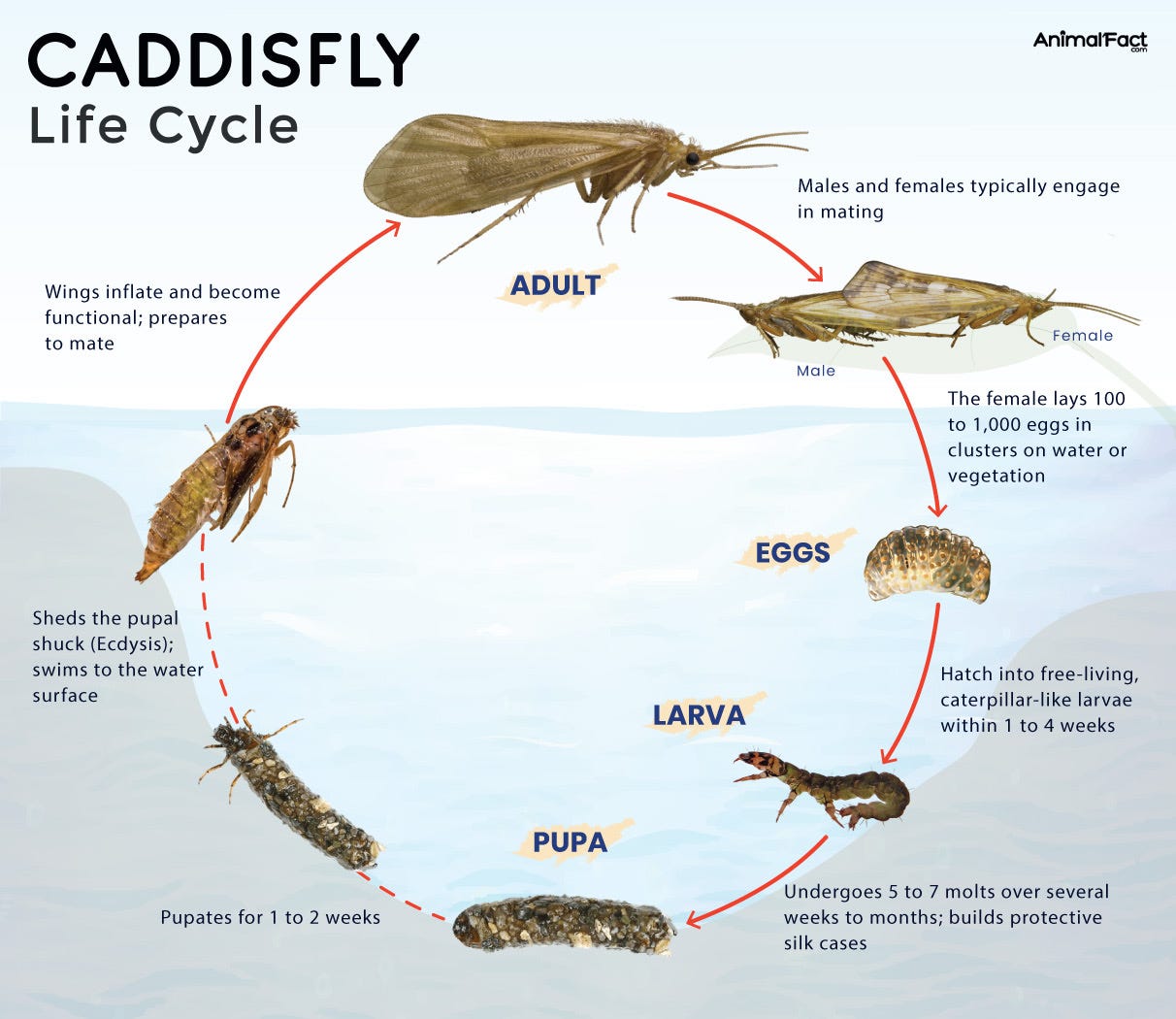
A caddisfly begins life as an egg, usually laid in or near the water. From the egg emerges a tiny larva, and this is the stage that spends much of its life underwater. Depending on the species, the larva may build a case like the ones I found, or it may live in a fixed shelter, among rocks, or in vegetation.
The larva grows through several stages, adding to or repairing its shelter as it grows. Eventually, when it is ready to transform, it enters the pupal stage underwater. After completing its metamorphosis, the adult caddisfly emerges from the water, often crawling or swimming to the surface before taking flight.
The adult stage is relatively short compared with the time spent underwater. Adults mate, females lay eggs, and the cycle begins again.
So those tiny stone cases I was looking at weren't just interesting little structures. They were evidence of one chapter in the life of an insect that spends most of its existence hidden beneath the surface of the creek.
And eventually, many of them become food themselves.
For trout.
Which brings me right back to fishing. For years, I walked streams looking under rocks for clues about what the fish are eating. Mayflies. Stoneflies. Caddisflies.
It's one of the great detective games of fishing. You look at the water. You turn over a rock. You find the bugs. Then you try to figure out what imitation to put on the end of your line.
But standing there looking at these tiny stone cases made me think about the creek from a completely different perspective.
These aren't just “bugs.” They're part of the machinery of the entire stream. They scrape algae from the rocks. They process organic material. They become food for trout. And eventually they emerge as flying insects and become food for birds, bats and all sorts of other creatures.
The creek is a giant food web, and these tiny creatures are right in the middle of it. They're also one of the clues we can use to understand the health of the water.
Caddisflies, along with mayflies and stoneflies, are important aquatic insects for assessing stream ecosystems. Many species are sensitive to pollution and require clean, well-oxygenated water. So when you find a healthy population of these little guys living in the current, you're seeing more than insects. You're seeing evidence of a functioning ecosystem.
I've spent a lot of years chasing trout and studying the insects they eat. But the older I get, the more I appreciate the things beneath the obvious. A trout rising to a caddisfly is exciting.
But discovering the tiny stone house that produced that caddisfly? That's a different kind of thrill. It's the thrill of realizing that the creek is far more complicated—and far more alive—than it looks from the surface.
And in some places, attached to the rocks just below the surface, is an entire world. A tiny little world built out of sand, gravel, silk and water.
Amazing what a few bits of stone and sand mean to our healthy ecosystems that we depend on without realizing it. Thanks. This is awesome!