
The Context of Quamash

by David Stalling
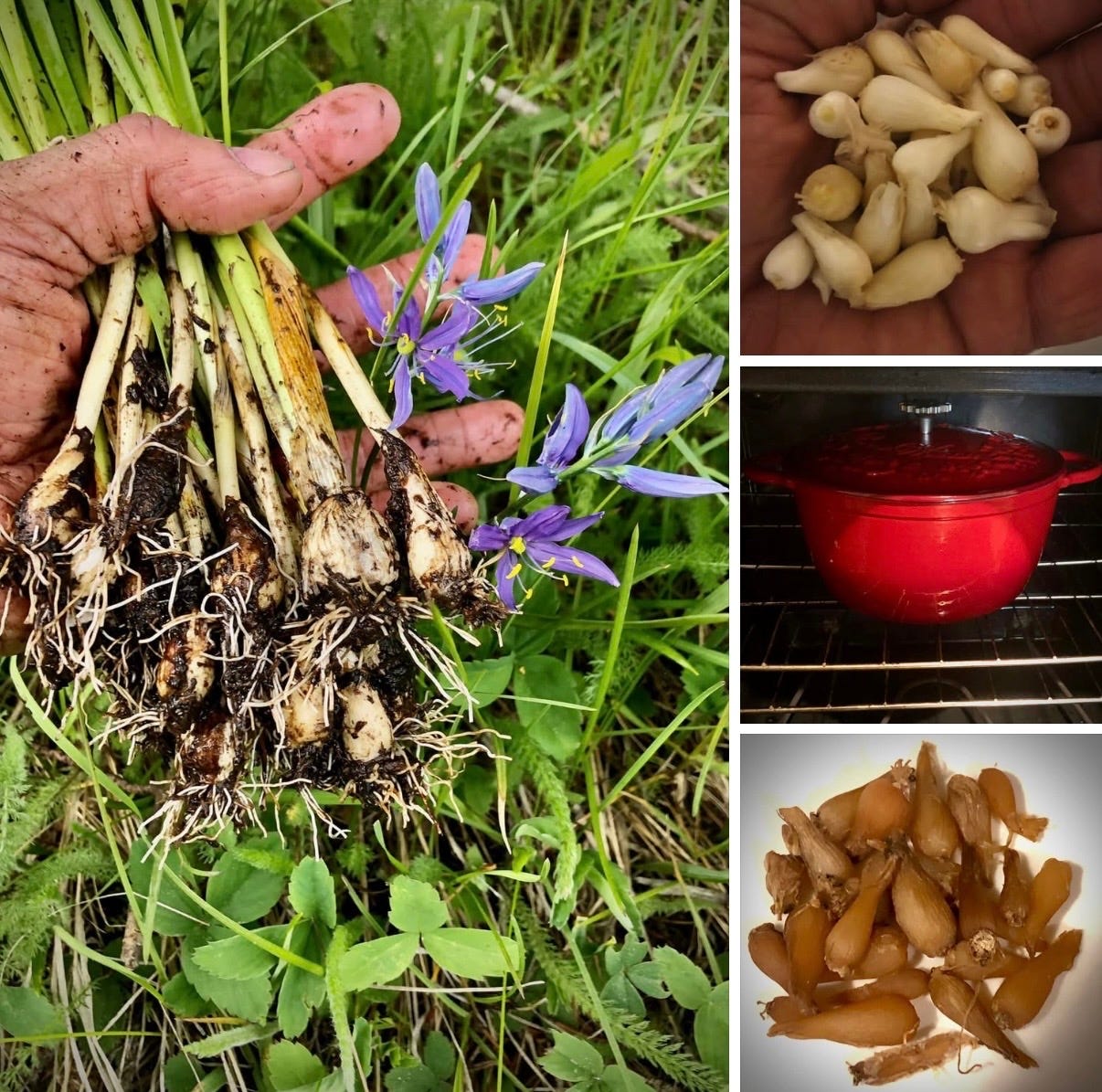
Last year I dug up some camas roots — quamash, as the Niimíipuu call it — figuring I’d see for myself what all the fuss was about. This unassuming little plant was once a staple for the Salish, Nez Perce, and other Native tribes, who used it for everything from bread to medicine. Lewis and Clark even depended on it when they were running low on food, though “depended” might be a generous word, considering how that first experience went for them.
Turns out, if you don’t know what you’re doing, camas will absolutely humble you. The explorers learned that the hard way. Not being used to the plant — or to its tricky chemistry — they ate too much, too fast. The result? A lot of suffering and some vividly miserable journal entries.
The culprit is inulin, a starch that doesn’t sit well unless it’s broken down properly. Eat it raw or undercooked, and your stomach lets you know. Cook it right, though — long and slow — and that same compound transforms into fructose, and suddenly you’ve got something sweet, rich, and actually worth the trouble.
So I decided to do it right. I baked the roots low and slow, about 225 degrees for a full 24 hours. No shortcuts. If people used to cook these in earth ovens for days, I figured I could at least commit to a day.
And honestly? They’re interesting. Sweet, definitely. I’ve seen them compared to baked pear, prune, sweet chestnut — even fried banana — and somehow all of those are accurate.
It’s a strange, layered sweetness, not quite like anything else. Pretty good, actually. But also a lot of work. The kind of food that makes you understand why it mattered so much, and why people built traditions around preparing it.
What stuck with me most, though, wasn’t just the taste, it was the context.
I recently read Braiding Sweetgrass by Robin Wall Kimmerer, and it’s been rattling around in my head ever since. She talks about how Indigenous knowledge and modern science don’t have to be at odds — that they can, and should, inform each other. One idea in particular lingered: the notion that plants like sweetgrass didn’t just get used by humans, they evolved alongside them. A kind of partnership, shaped over thousands of years of careful harvesting and reciprocity.
It makes you wonder about camas. If people have been using plants like this for tens of thousands of years, it’s not just a one-way relationship. There’s an entanglement there — a back-and-forth, a quiet coevolution. The plant feeds the people, the people tend the land, and somewhere in that exchange, both are changed.
Standing there with a handful of roots I’d dug up myself, I felt a small piece of that connection. Not in some grand, mystical sense — just in the simple realization that this wasn’t just food. It was knowledge. Hard-earned, passed down, and very easy to get wrong if you don’t respect it.
And yeah, after all that?
I’ll do it again. Soon!
Humans and plants co-domesticating one another? Subtle but profound. Quite an interesting observation.
So much has been denigrated, ignored, and discarded from the long established uses discovered and employed by pre-scientific people. No one can say how much has been lost by that arrogance.