by David Stalling

Part I: Myths of Manhood

I grew up
with a war hidden under my ribs.

Not the kind with flags
or history books
or heroes carved in stone.
Just a quiet, relentless battle
between my own heart
and everything I believed
a man was supposed to be.

I knew early.
Before I had language for it.
Before I understood desire.
Before I understood
how dangerous shame could become
inside a young boy trying to survive himself.

I just knew
that something in me moved toward men naturally.
That certain smiles stayed with me too long.
That my attention lingered.
That my heart recognized something
I was terrified to name.

And I believed I could beat it.

Not accept it.
Not understand it.
Beat it.

Like it was weakness.
Like it was failure.
Like it was something I could bury
under enough toughness,
enough recklessness,
enough masculinity performed at full volume.

So I built a version of myself
that nobody would question.

I bought into every myth
about what a man was supposed to be.
Hard.
Aggressive.
Fearless.
Untouchable.

I fought constantly.
Like violence could silence something inside me.
I wrecked a lot of cars.
Pushed limits.
Lived recklessly enough
to drown out my own thoughts.

I became the wildest person in every room
because if I stayed moving fast enough,
maybe I would never have to stop
and face the truth about myself.

And then I joined the Marines.

Not because I was brave, necessarily,
but because I thought becoming harder
might finally fix me.

I pushed further.
Force Recon.
Sergeant.
More intensity.
More danger.
More proof
(to myself more than anyone)
that I was the kind of man
I thought I was supposed to be.

But no amount of toughness
could change the direction of my heart.

But still,
I fought it.


Part II: Unbearable Shame

After the Marines,
when I still believed discipline
could outmuscle desire,
I met a woman
who seemed to carry light with her
in a way I did not understand myself.

Beautiful.
Intelligent.
Grounded in a way that made me think
maybe I could finally become
the version of me I was always chasing
if I just built a life strong enough around it.

I married her
with something like hope
and something like desperation,
believing love in that form
might quiet the war inside me.
That if I did everything “right,”
if I lived the life expected of me,
the rest of me would finally settle down
and disappear.

But desire does not vanish
because it is negotiated with.
And truth does not soften
just because it is surrounded by good intentions.

I carried guilt I did not yet have language for,
and shame I thought I had already outgrown.

Still, what we built together was real.
There was care there.
Respect.
Moments of genuine connection
that were not false,
even if I was.

And we have a child,
a life I would not trade,
a person who ties us together
in something that will always matter more
than the way everything else fell apart.

Even now,
she remains someone I care for deeply,
not as a past mistake to erase,
but as a person who lived through my confusion
alongside me.

And I have had to learn
that love can be real
and still not be the place
you are meant to stay.

That harm and tenderness
can exist in the same story.

That sometimes you do not break people
so much as you wake up
and realize you were never fully present
when you were with them.

And that realization
has its own kind of grief.
Turmoil.
Confusion.
Despair.

Shame followed me everywhere.

Not loud all the time.
Sometimes quiet.
Sometimes buried deep beneath achievement
and performance
and noise.

But always there.

There were nights
when the exhaustion of carrying it
felt unbearable.

Moments where the loneliness became so deep
I honestly did not know
if I would survive myself.

Because when you spend years believing
you can outrun who you are,
every failure to change becomes another reason
to hate yourself more.

So while other people were becoming,
having first crushes,
first kisses,
young love,
messy heartbreaks,
learning intimacy naturally,

I was building armor.

I was surviving through performance.
Trying to become so undeniably masculine
that maybe the rest of me would disappear.

And survival steals time.


Part III: Out in the Wilds

And when the noise of people
became too much,
I disappeared into wild places.

Deserts.
Mountains.
Forests.

Remote places where nobody cared
who I was supposed to be.
Because out there,
nature does not measure masculinity.

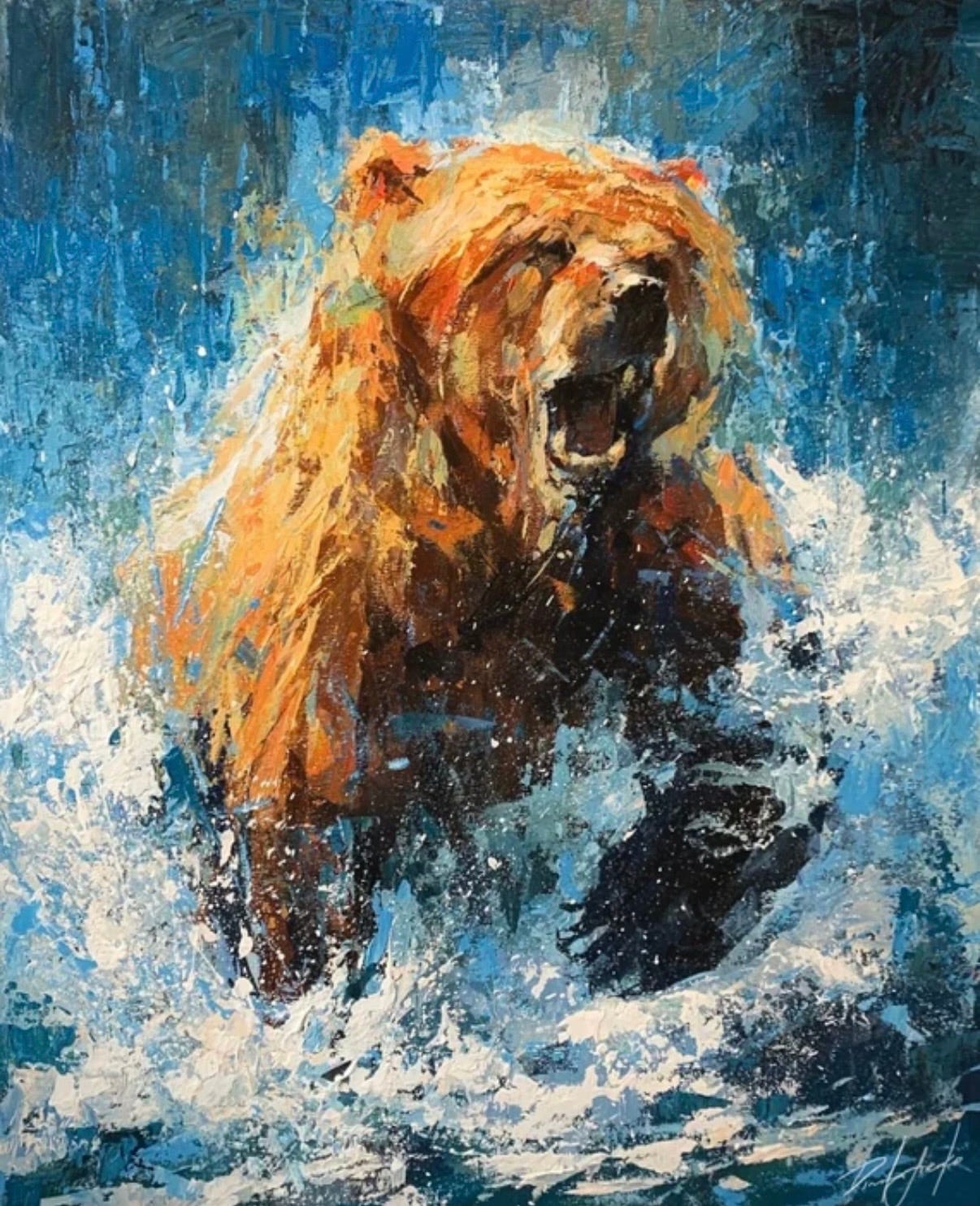
Grizzly bears might see me
as a threat,
or a feast,
but they don’t care
whether I fit inside society’s definition
of manhood.

The mountains do not judge me.
The rivers do not shame me.
The wilderness asks nothing from me,
except honesty.

Everything there simply is
what it is.

And for the first time in my life,
I could exist that way too.

Out there,
alone in the wild,
I do not feel defective.
I do not feel watched.
I do not feel like I am failing
some invisible test.

I could finally unclench.

It was grizzly bears,
observing them,
learning from them,
who finally gave me something
I had never had before:

The courage to be myself.
To be wild and free.
To face the world like grizzlies do:

With honesty,
presence,
and courage.

Without apology
for simply existing
as I am.

And because of that,
the wilderness became more than escape.
It became home.

Teacher.
Refuge.
A place that shaped me
as deeply as pain shaped me.

The wild gave me something
people often did not:
peace.

It taught me
there is nothing unnatural
about simply existing
as you are.

When I finally came out,
people saw honesty.
Freedom.
Relief.

What they could not see
were all the missing years underneath it.


Part IV: Growing Up (Again)

The emotional life
that had been delayed.

I had never learned
the ordinary things
other people learned young.

How to love openly.
How to let someone close.
How to be vulnerable without fear.
How to experience desire
without shame attached to it.

So many firsts came late.

First real crush.
First kiss.
First love.
First time being wanted openly.
First heartbreak.

I experienced them like someone
trying to recover lost time
with trembling hands.

And when all those locked doors finally opened,
they did not open gently.

(I don’t do anything gently.)

I relived my youth
like a flood breaking through a dam.

My house became party central:
music,
men,
sex,
drugs,
chaos.

Gay college students filling the rooms
because somewhere inside myself,
that was the age I felt.

It was never about chasing younger men.
It was about chasing the years
I never got to have.

I was trying to catch up to my own life.

So I partied too hard.
Dove headfirst into freedom without limits,
because I had spent so many years
starving every part of myself.

And starving people,
when finally allowed to eat,
do not always know when to stop.

I lost a lot during those years.
Jobs.
A house.
Pieces of myself.
Stability.
Friendships.
Time.

I hurt myself in different ways.
Not through hiding anymore,
but through excess.

Because even freedom,
when it arrives after a lifetime of suppression,
can become its own kind of chaos.

And eventually,
I had to rebuild my life
from the wreckage of both versions of myself:

The man who tried to destroy his identity,
and the man who nearly destroyed himself
celebrating it.

That is what hiding does to a person.

It does not only hurt you in the moment.
It interrupts your becoming.
It steals years from you
and then asks you to keep moving
like nothing happened.

And there is grief in that.
Real grief.

For the boy who thought
he had to turn himself into a weapon
just to survive his own heart.

For the young man
who mistook hardness for healing.

For all the years spent trying to conquer something
that was never wrong to begin with.

Because now I understand this:
there was never anything weak
about loving men.

The tragedy was never my heart.

The tragedy
was how hard I fought
against it.
This Substack is reader-supported. To receive new posts and support my work, consider becoming a free or paid subscriber.


I adore this
Well said